AD&D Monster Manual (1979)
Gary Gygax, Advanced Dungeons & Dragons Monster Manual, 4th ed. (Lake Geneva, WI: TSR, Inc., 1979).
Dragons come in many colors, sizes, shapes, and alignments. Two sorts of dragons (the Chromatic Dragon and the Platinum Dragon) are singular individuals, and there are no others of their type. Each dragon sort will be treated individually hereafter. General information and common characteristics will be given here.
The ten species of dragons have three general size categories (small, average, and huge) according to the size typical of each. This categorization is determined by die roll. An 8-sided die is rolled: 1-2 = small, 3-7 = average, 8 = huge. This size determination indicates the number of hit dice a dragon has.
Dragons pass through eight ages in their lives. These growth stages are:
| 1. Very young — 1-5 years | — 1 hit point per die |
| 2. Young — 6-15 years | — 2 hit point per die |
| 3. Sub-adult — 16-25 years | — 3 hit point per die |
| 4. Young adult — 26-50 years | — 4 hit point per die |
| 5. Adult — 51-100 years | — 5 hit point per die |
| 6. Old — 101-200 years | — 6 hit point per die |
| 7. Very old — 201-400 years | — 7 hit point per die |
| 8. Ancient — 401 + years | — 8 hit point per die |
To determine the age (and thus the number of hit points per die a dragon has) simply roll an 8-sided die, the number rolled indicating the age as shown above.
All dragons see equally well in daylight or darkness (infravision, 60’). They have excellent sight, smell, and hearing. Because of these keen senses, all dragons are able to detect hidden or invisible creatures within 1” per age level. Dragons also develop the power to panic enemies as they mature. At adult age and older they radiate a powerful aura which causes a fear
Treasure: Very young dragons will usually have no treasure, but there is a 10% chance that they will have one-quarter the possible listed treasure. Young dragons have 25% chance for one-quarter the possible listed treasure. Sub-adults have a 50% chance for one-half the possible listed treasure. Young adults, and old dragons have normal treasure. Very old and ancient dragons are 50% and 75% likely to have 150% and 200% respectively of the listed treasure.
Weaknesses of Dragons: The innate cowardice of dragonkind is shown by the fact most can be subdued. Dragons’ egoistic nature makes them subject to flattery, and it also makes the more stupid of them prone to attack other powerful creatures whom they view as disputing their dominating position. Greed and avarice are major motivating factors in all but the loftiest of dragons (40% of silver, 80% of gold, and the platinum dragon), so they are subject to manipulation by very clever persons or the prospect of actual treasure and the promise of more forthcoming.
White Dragon (Draco Rigidus Frigidus)
| FREQUENCY: Uncommon |
| NO. APPEARING: 1-4 |
| ARMOR CLASS: 3 |
| MOVE: 12”/30” |
| HIT DICE: 5-7 |
| % IN LAIR: 20% |
| TREASURE TYPE: E, O, S |
| NO. OF ATTACKS: 3 |
| DAMAGE/ATTACK: 1-4/1-4/2-16 |
| SPECIAL ATTACKS: Breath weapon |
| SPECIAL DEFENSES: Nil |
| MAGIC RESISTANCE: Standard |
| INTELLIGENCE: Average (low) |
| ALIGNMENT: Chaotic evil |
| SIZE: L (24’ long) |
| PSIONIC ABILITY: Nil |
| - Attack/Defense Modes: Nil |
| CHANCE OF: |
| - Speaking: 20% |
| - Magic Use: 5% |
| - Sleeping: 60% |
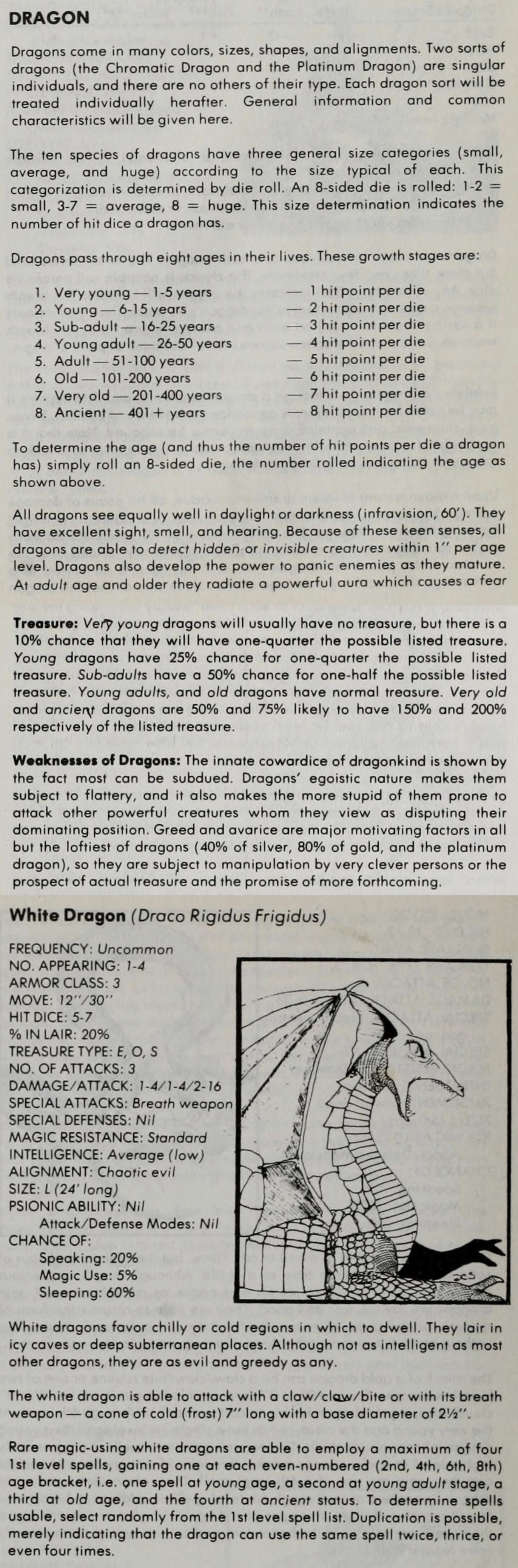
White dragons favor chilly or cold regions in which to dwell. They lair in icy caves or deep subterranean places. Although not as intelligent as most other dragons, they are as evil and greedy as any.
The white dragon is able to attack with a claw/claw/bite or with its breath weapon — a cone of cold (frost) 7” long with a base diameter of 2½”.
Rare magic-using white dragons are able to employ a maximum of four 1st level spells, gaining one at each even-numbered (2nd, 4th, 6th, 8th) age bracket, i.e. one spell at young age, a second at young adult age, a third at old age, and the fourth at ancient status. To determine spells usable, select randomly from the 1st level spell list. Duplication is possible, merely indicating that the dragon can use the same spell twice, thrice, or even four times.